
About DGS
Founder-led and built.
An independent UK studio built around quality, fairness and player respect.
Departure Gate Studios Ltd is the independent studio behind Ascendle® and Ascendle Arena®.
DGS was not formed to search for a game. It began with one question, asked in an airport departure lounge by someone who had never written code.
What followed became substantial, distinctive and serious enough to need a company behind it. The game grew until it needed a studio.
Born at an airport departure gate
Ascendle® began in a departure lounge at George Bush Intercontinental Airport in Houston, while waiting three hours for an international flight home.
Travel had broken a long-running daily word-puzzle streak - not through a failed outcome, but because a day had been missed. That daily-return model makes sense through certain lenses, but it prompted a question: could a streak be maintained without being punitive for missing a day?
Other frustrations had been accumulating. A rigid active row made it difficult to build and preserve a word shape. Known letters could become an input obstacle rather than useful information. Much of the real solving work had to be held in the player’s head instead of being worked through naturally on the board.
A news item about Google Gemini’s improving coding capability prompted a simple question:
“If I have an idea, can you code it for me?”
There was no plan to build a game or form a studio, and no previous coding experience. Gemini produced a small HTML file, explained how to save it in a phone editor and open it in a browser. Within roughly half an hour, a rudimentary five-letter puzzle was running, and the brand that was to become Ascendle® was born.
The name Departure Gate Studios comes directly from where that first question was asked.
Built through judgement, not noise
The first prototype proved only that the idea could work. It did not answer what the game should become.
What followed was a deep process of building, breaking, questioning and rebuilding. A single HTML file became a structured browser application. New mechanics created new edge cases. Word lists had to be assembled and governed. Scoring, answer selection, persistence, security, analysis and competition all had to be understood rather than merely made to run.
Emerging tools made that possible, but they had to be directed, challenged and controlled. Generated code was never treated as authority. Ideas were tested in isolated sandboxes, systems were replayed at scale, and internal technical papers were developed to examine whether the logic actually supported the intended experience.
The founder’s background in engineering and toolmaking shaped that process: define what the mechanism must do, understand why it fails and keep refining it until the behaviour is dependable.
The tools accelerated the build. The judgement shaped the product.
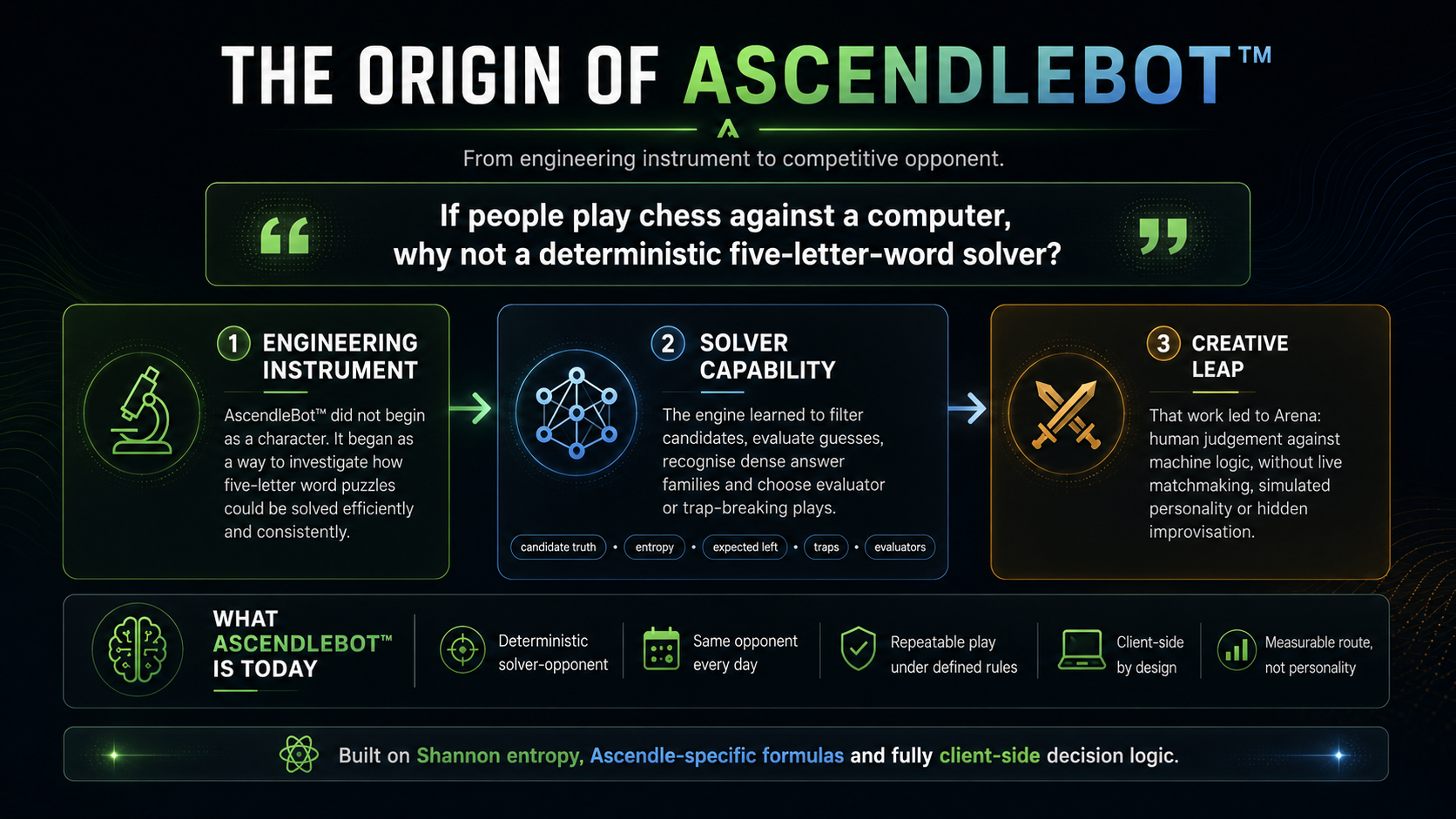
AscendleBoT™ followed the same path. It began as an engineering instrument for understanding efficient puzzle solving. The creative leap was to turn that deterministic solver into an opponent—and Ascendle Arena® followed.
The values behind the build
DGS has not approached development as a race to add the greatest number of features.
Ideas have been retained when they make play clearer, more natural, fairer or more useful to understand. Others have been challenged, simplified or stopped when their complexity no longer justified the player benefit. Many ideas have been scrapped.
The same care has applied beyond gameplay: understanding intellectual-property boundaries, testing where Ascendle is materially different, protecting the primary product identities and separating confident product claims from assumptions that still require evidence.
The studio’s approach is practical:
Test the idea. Build the system. Examine the behaviour. Keep only what makes the experience better.
Built to respect the player
Departure Gate Studios believes the business model should respect the game and the person playing it.
Ascendle® and Ascendle Arena® have not been designed around pay-to-win mechanics, deliberately obstructive advertising or long interruptions that return no meaningful value.
Monetisation should support continued development without changing the integrity of the result. Paid options should improve the experience, not purchase success. Advertising, where used, should be limited and purposeful.
The same principle extends to the games themselves. Results should be understandable. Competition should have a fair basis. Progress should belong to the player, and deeper systems should help people improve rather than merely tell them that they lost.
The game should respect the player’s time and reward the attention they choose to give it.